

HACCP and food inspections compared internationally
From the USA to Japan, authorities inspect differently. A robust self-control system holds up everywhere.
FIRST THINGS FIRST
What food inspections worldwide are really about
Whether a single-site operator or an internationally operating multi-site structure. Whether Germany, USA, Denmark, Japan, or Qatar.
Food inspections follow the same fundamental questions worldwide.
It is not the location that determines the outcome of an inspection. What matters is whether an operation knows, manages, and visibly controls its food safety risks in daily operations.
This page explains the shared logic behind official food inspections, food safety monitoring, and internal self-monitoring systems worldwide.
It shows why food inspections are rarely random and why inspection-ready operations remain stable regardless of size, region, authority, or inspector.
Today, flowtify is actively used in over 9.000 locations across 15 countries, creating a shared foundation for international food safety inspections across borders.
What authorities assess at their core
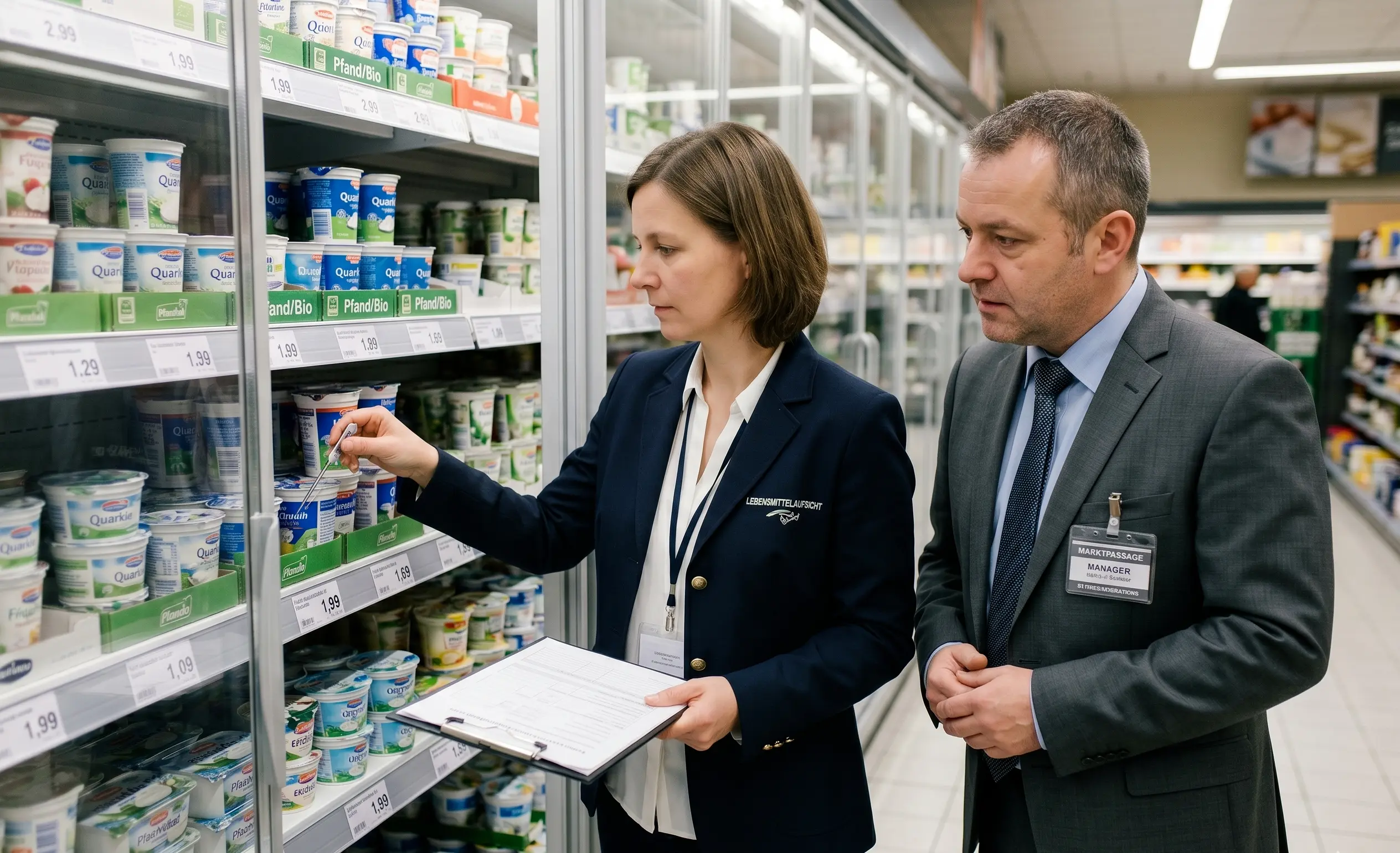
Food inspections are stress tests for operational systems. Not under ideal conditions, but during live operations.
In daily operations, under time pressure or in unexpected situations, it becomes clear whether processes are robust or merely formally described.
- Are processes carried out the way they are described?
- Are deviations documented in a traceable way?
- Are actions proportionate to the risk?
An inspection during the rush hour remains demanding. However, the decisive factor is not the timing of the inspection, but whether procedures function transparently even under pressure.
Authorities verify whether mandatory documentation records are in place. These serve as the basis for assessing how risks are managed in the operation.
But it does not stop at formal verification. Inspections assess whether documentation and actual operational practice are consistent.
This is where the difference lies between formal compliance and lived systematics. Both are necessary.
An operation is inspection-ready when evidence and reality consistently match, not just in normal operations, but also under real pressure conditions.
This logic applies to the single-site operator just as much as to multi-level multi-site structures. The requirements remain the same. What differs is only how many processes must be managed and documented simultaneously.
An operation is inspection-ready when records and reality consistently match.
Why inspection-ready operations remain stable
Food inspections worldwide follow a shared fundamental principle: what is assessed is not a snapshot, but whether an operational system functions.
The decisive factor is whether processes are transparently defined, implemented in daily operations, and consistently documented.
In practice, this is not only about temperatures or cleaning records, but also about responsibilities, training levels, and response mechanisms for deviations.
Inspections frequently focus on interfaces. Goods receiving, cold chain, production start, peak service times, or shift changes are typical inspection areas because organizational weaknesses become visible here.
For operational management this means: self-monitoring systems must not only be complete but logically structured. Checklists without clear responsibility or without defined escalation paths lose their validity.
Digital documentation creates transparency when records are not documented in isolation but embedded in a process. The critical link is between measurement, assessment, and action.
Across sites this creates a solid picture. Deviation patterns can be compared, training needs become visible, and operational risks are identified early.
Control logic varies by country. What is ultimately assessed everywhere is the same day-to-day reliability: clear responsibilities, robust self-monitoring, and transparent correction of deviations.
This logic also holds up in the daily reality of flowtify customers, whose sites are inspected across Western Europe, the United States, Japan, and Qatar. Which authority shows up is secondary. What matters is whether the self-control system holds.
FIVE COUNTRIES, FIVE WAYS
Different inspection approaches worldwide
Why food inspections differ by country in effect, even though they assess by similar principles.
Food inspections pursue the same objective worldwide. They assess whether operations are capable of independently identifying, monitoring, and controlling health risks.
What differs is not the inspection logic, but the way in which control is implemented.
In some countries, transparency and proportionality take precedence. In others, transparency, public visibility, or immediate sanctions carry more weight. Others focus primarily on system discipline, standardization, and preventive process management.
Understanding these approaches enables operations to build self-monitoring systems that remain stable even with changing inspectors, regions, and regulatory frameworks.
How food control is approached worldwide
These different mechanisms explain why food inspections feel different depending on region or market.
Risk-based assessment
Inspection focuses on traceability, proportionality, and whether operational decisions are technically justified.
Example: EU & Germany

Public transparency
Inspection results are published in a standardized format and made visible to consumers. Steering effect also arises from market comparability.
Example: Denmark

Transparency with enforcement
Ratings are more closely tied to timely conditions, follow-up inspections, or operational consequences. Steering effect arises from visibility plus reaction speed.
Example: USA

Preventive system stability
Inspections check whether HACCP-based self-control systems are structurally sound and whether processes function reproducibly over time.
Example: Japan

Regulatory conformity
The regulatory framework is tightly defined, so deviations can trigger formal action more quickly. What counts is demonstrable compliance.
Example: Middle East

What they all share
However inspections are run, what ultimately matters is whether the self-control system holds up in daily operations.
Synthesis of all models
What this means for international standards, inspection intervals, and manageability
Inspection systems differ less in their objective than in their methodology. Some countries rely on announced routine inspections; others work more with unannounced spot checks or focused actions.
Inspection depth also varies. While some systems focus primarily on documentation and evidence, other authorities place greater weight on on-site observation.
Frequency is also not uniformly regulated internationally. Risk classes, size of operation, product type, or previous complaints influence how often inspections take place.
For operational management this means: processes should be built not only to comply locally but to be structurally consistent.
Digital documentation systems help to map different requirements without constantly redefining operational procedures.
Risk-based assessment
Risk-based classification rather than schematic assessment
Why EU authorities weigh context, proportionality, and risk classes together
In many European countries, official food inspection is strongly shaped by transparency and proportionality.
Not every deviation automatically leads to consequences. The decisive factor is whether operations can demonstrate that they identify, assess, and appropriately manage risks.
Particularly in federally organized countries such as Germany, this approach is clearly visible. The legal foundations are uniform, but practical inspection is conducted regionally.
Inspections aim to understand how operations make decisions. Those who can explain deviations, justify measures, and demonstrate connections generally experience inspections as more predictable.
How EU member states assess deviations in operational context
Risk-based food inspection is not a pure checklist comparison, but a professional assessment of operational reality.
Not every deviation automatically leads to a measure. The decisive factor is whether it becomes apparent that risks are understood, assessed, and appropriately managed within the self-monitoring system.
The focus is not on the individual deficiency, but on the question: Is the underlying system robust?
Operations that can explain their processes, classify deviations transparently, and derive measures plausibly experience inspections in this environment noticeably more stably.
What risk classes, inspection intervals, and documentation quality practically trigger
Risk-based food inspection shapes food safety monitoring in Germany and many EU member states. What is assessed is not an isolated individual deficiency but the overall system of a food business.
The basis is classification into a risk class. This considers the type of operation, target group, production volume, and the concrete hazard potential of the products offered.
Those who structure their self-monitoring system clearly, keep documentation evaluable, and systematically track measures create greater security in risk-based food inspection.
Public transparency
Transparency as a control instrument
In some countries, food inspection operates less through formal procedures than through public visibility. Food inspection in Denmark is a well-known example of this approach.
Operations are therefore not only in exchange with inspectors. They simultaneously become recognizable and comparable in the market.
How public hygiene assessment creates effect and comparability
Transparency does not change the professional logic of food inspection, but its reach. The inspection itself remains risk-based.
In Denmark, the results of official food inspections are systematically made public. The smiley system in particular is well known for presenting inspection results in an easily understandable way.
Previous inspection results are also frequently accessible online, allowing consumers to track developments across multiple inspections.
What the smiley system demands operationally and how it assesses over time
In Denmark, results of official food inspections are published systematically. The hygiene assessment is present in the operation and permanently accessible online.
For operations this means: good hygiene practice, HACCP implementation, and self-monitoring systems have an effect not only internally. Their stability becomes permanently transparent to guests.
Transparency with enforcement
Combining visibility and enforcement
Why transparency in the USA is frequently linked to clear follow-up processes and consequences
In many regions of the USA, food inspection is organized visibly and bindingly. Inspection results are presented so that they are easy for consumers to interpret.
For operations, this creates high pressure to act. Deviations do not remain abstract but quickly become relevant to ongoing operations.
How public assessments are linked to requirements, deadlines, and follow-up inspections
Inspection results are frequently published as easy-to-understand assessments and made visible at the entrance of the operation.
This visibility is regularly linked to clearly defined follow-up processes. Depending on the result, prompt follow-up inspections, requirements, or further measures may follow.
The role of health departments, letter grades, and food code in practice
In many regions of the USA, food inspection is conducted by the responsible health department through standardized restaurant inspections. Results are frequently published using a letter grade system.
A stable system not only reduces regulatory risk but also protects reputation and demand. Where inspection and public assessment work closely together, the quality of an operation becomes immediately apparent.
Preventive system stability
System discipline rather than public assessment
How Japan secures food safety through standardization, HACCP, and process stability
In Japan, public assessment plays a lesser role in food inspection. The focus is on stable processes, clear standards, and consistent implementation in daily operations.
HACCP is mandatory in Japan and deeply integrated into operational procedures. Inspections assess whether these HACCP-based systems function continuously.
Why HACCP there is considered an organizational standard, not a formality
The focus is less on public assessment than on the structural stability of operational processes.
The decisive factor is not the formal existence of a HACCP plan, but its demonstrable implementation in daily operations.
What process stability, standardization, and root-cause work mean in inspections
Food inspection in Japan is closely linked to the mandatory introduction of HACCP. The focus is not on publicly assessing individual results, but on whether processes are standardized, reproducible, and durably and effectively controlled.
System stability thus becomes the central quality characteristic. It is not external impact that decides, but the consistent management of risks in daily operations.
Regulatory conformity
High regulation and strict sanctions
How strongly regulated markets in the Middle East consistently enforce food safety
In strongly regulated markets of the Middle East, food inspection is closely tied to clearly defined state requirements. The regulatory framework is precisely formulated and leaves little room for deviations.
For operations, this creates an environment with clear expectations. The focus is not on interpreting regulations but on their demonstrable implementation in daily operations.
How regulatory conformity is assessed and why margins are narrow
The difference lies in the narrow regulatory framework. Requirements are described in detail and oriented toward immediate conformity.
A structured self-monitoring system is under these conditions not an option but a prerequisite for lasting conformity.
Which records, responsibilities, and documentation logic hold over time
Inspections focus on demonstrable conformity. Temperature monitoring, traceability, personnel hygiene, and documented procedures must be verifiable at any time.
Food safety is understood in this environment as the continuous fulfilment of binding standards. System stability is the foundation for sustainable business operations in the region.
Which system fits your operation?
When sites are inspected across countries and inspection cultures, it pays to look at how self-checks, documentation, and deviation management can work together in a single platform.
Book a consultationTHE COMMON THREAD
What all food inspections have in common
The fundamental question assessed everywhere and why system capability decides
As differently as food inspections are perceived worldwide, their core is remarkably similar. Authorities do not assess by chance or by personal judgement. The same question is always at the center: Is an operation capable of independently identifying, monitoring, and effectively managing food safety requirements in daily operations?
This shared inspection logic connects very different inspection cultures. It explains why operations with stable self-monitoring systems can remain comparably secure in very different countries.
What authorities assess at their core worldwide
Food inspections differ in style, visibility, and consequences. What connects them is the professional core question that is asked everywhere.
Inspections assess whether decisions are transparent. Whether measures match the actual risk. And whether the self-monitoring system remains stable under pressure.
Why self-monitoring is the international constant
Regardless of the respective inspection system, food inspections worldwide follow a comparable structure. What is assessed is not a single measure but the functional capacity of the entire self-monitoring system.
International comparability does not arise through identical laws but through identical inspection logic. Those who analyze risks in a structured way, define control points cleanly, and systematically track measures strengthen not only inspection security but also operational stability.
Food inspections as a mirror of daily practice
Operational audits in daily business show whether self-monitoring, HACCP, and documentation reliably function in practice
An operational audit shows whether the system holds
An operational audit is not an appointment that one prepares well and then checks off. It shows during live operations whether hygiene practice, responsibilities, and self-monitoring function reliably.
Operations that run self-monitoring as a daily management process experience operational audits as significantly more predictable.
Where inspectors get caught in daily operations
In practice, it is rarely a major scandal that determines the impression of an operational audit. Frequently it is small breaks in daily operations: temperature measurements are in place but only documented after the fact. Cleaning records are complete but without clear verification and feedback loops.
This makes the operational audit feedback for operational management. It confirms not only conformity, it shows where processes run stably and where targeted improvement is needed.
Related topics

Operational quality assurance at the single site
Where responsibility takes shape day-to-day and shows up clearly

Build multi-site structures so locations remain comparable
How responsibilities and standards are built so locations remain comparable

Security and compliance
Certified infrastructure, encrypted data, and traceable audit trails
International inspection requirements. One system.
In the conversation we clarify how self-monitoring, documentation, and deviation management can function reliably across all sites.